Why Concert Earplugs With 24 dB Protect 41% More Than the Popular £25 Alternative, And Still Let You Hear the Music
A look at what decibel ratings actually mean for your hearing at 100 dB concerts, and why the difference between 17 dB and 24 dB is not a marketing number.
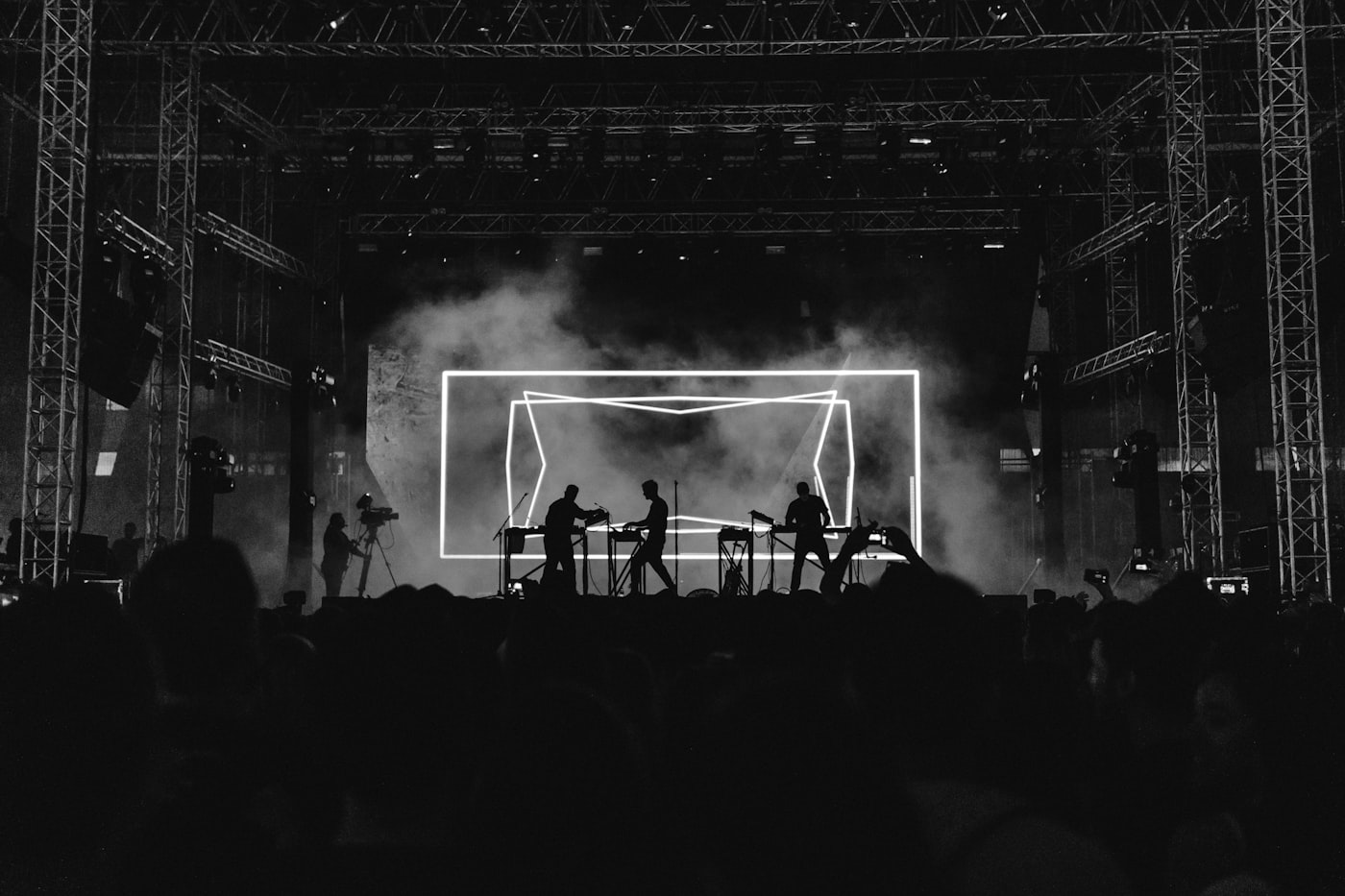
The Exposure Clock Starts the Moment You Walk In
At 100 decibels, the volume measured at a standard club night or festival main stage, the World Health Organisation sets safe continuous exposure at 15 minutes.
Not 15 hours. Not 15 songs. Fifteen minutes.
After that, cochlear hair cells begin to sustain damage. Those cells do not regenerate. Every additional minute at unprotected 100 dB compounds what audiologists call noise-induced hearing loss (NIHL): a condition that is permanent, cumulative, and completely preventable.
Most concertgoers know, somewhere, that loud music is risky. What most don't know is how the math actually works, and why the earplug they might be relying on could be leaving them significantly under-protected.
Why You Probably Wear Nothing
Here is the pattern that repeats at every festival: foam earplugs go in before the headliner. The first two songs are muffled, muted, underwater. The bass is there but the highs are gone. The mix sounds like listening through a mattress. The earplugs come out. The next morning, there is ringing.
This is Post-Show Tinnitus Drift, the cumulative cochlear damage that builds across years of unprotected concert exposure. It is not dramatic. It does not announce itself. It shows up as the ringing that used to last two hours and now lasts three days. As the first signs of threshold shift: certain frequencies becoming harder to pick out in conversation.
Foam earplugs are not the solution. They muffle the music because foam absorbs high-frequency sound selectively, leaving the low end but killing the mids and highs that carry melody and definition. The music no longer sounds like music. So the earplugs come out, and the ears take the full hit.
You didn't skip the earplugs because you don't care about your hearing. You skipped them because foam ruins the music. That distinction matters for understanding what the solution actually needs to do.
"I was at Leeds Festival, took them out after the second song. Ears still ringing three days later."
What 7 Decibels Actually Means
Decibels are not linear. The scale is logarithmic, which means the difference between 17 dB and 24 dB of protection is not 41% more in any intuitive additive sense, it is a difference in acoustic physics that translates directly into permissible exposure time.
Here is what the WHO guidelines imply at a 100 dB concert:
| Earplug Protection | Ear Receives | Safe Exposure Time |
|---|---|---|
| No protection | 100 dB | 15 minutes |
| 17 dB reduction | 83 dB | Approximately 2 hours |
| 24 dB reduction | 76 dB | 8+ hours |
| Target safe threshold (76 dB) | 76 dB | Comfortable all-evening |
The difference between 17 dB and 24 dB at a 100 dB show is the difference between needing to leave after two hours and being protected for the entire set.
To state this plainly: a 17 dB earplug at a four-hour festival set still leaves you exposed beyond safe threshold for a significant portion of the evening. A 24 dB earplug keeps you comfortably within the WHO's safe continuous exposure range for the full duration.
The Patented Flat-Filter Mechanism
The reason foam earplugs ruin music is acoustic, not cosmetic. Foam absorbs high frequencies preferentially — the mids and highs that carry definition — while passing low frequencies. The result is a mix with bass and not much else. The earplug does not reduce volume uniformly; it distorts the frequency balance.
Flat-Filter Fidelity (USPTO Design Patent D961,757) addresses this at the physics level.
The Bollsen Music SoundPRO uses a precision acoustic channel machined to attenuate sound uniformly across the full frequency range — high, mid, and low. The channel is not an absorber; it is a resonant filter. Because it reduces all frequencies by the same amount, the frequency balance of the music is preserved. The mix sounds like itself, just quieter.
Lab-verified protection
24 dB SNR
ISO-certified across 1,700 independent measurements at PZT GmbH (Notified Body 1974 — EN 352-2 accreditation). The other popular concert earplug is certified at 17 dB.
Patented flat-filter preserves musical balance while cutting 24 dB — hear the music, not the damage.
The Professional's Choice
DJ Umek, the Slovenian techno artist with 30+ years in the booth and a catalogue of sets at clubs running consistent 103-108 dB, wears Bollsen Music SoundPRO.
This is not a licensing arrangement. Techno DJs do not do Coachella brand deals. Umek wears what works in the booth at the volume at which he plays.
The Music SoundPRO has 480+ five-star reviews. The pattern is consistent: music quality is preserved, the ringing is gone the next morning, and the earplugs stay in during dancing.
"No ringing the morning after, first time in five years of festivals. Music still sounds like music, just less ear-shattering."
What customers are saying
I'd been wearing Loop for two years. Tried these after reading about the SNR difference and honestly, the music sounds cleaner and there's no ringing the next day. The 7 dB gap is real.
Glastonbury 2025. Wore these for six hours across three stages including the Pyramid at full volume. Ears completely clear the next morning. I've been going for eight years and that has never happened before.
The keychain case is the thing. I always forgot my old earplugs. These have been on my keys for three months and I've used them at every show.
Nobody Knows. You Do.
The Music SoundPRO triple-flange silicone is transparent. At any distance beyond arm's reach, it is invisible in the ear. There is no visible stem, no coloured ring, no fashion accessory.
This matters for two reasons. First, the practical one: the earplugs stay in. Triple-flange silicone creates a mechanical seal that does not vibrate loose during dancing or dislodge when you turn your head in a crowd. The fit is not a press-in, it is a lock.
Second, the social one: wearing hearing protection at a concert does not need to be announced. The protection is private. The experience is full.
Nobody Knows. You Do. Invisible fit. Full protection. Zero compromise.
Bollsen Music SoundPRO vs Loop Experience 2
| Feature | Bollsen Music SoundPRO | Loop Experience 2 |
|---|---|---|
| Price | £26.95 | £25.00 |
| SNR Rating (ISO-certified) | 24 dB | 17 dB |
| Safe exposure at 100 dB venue | 8+ hours | ~2 hours |
| Acoustic technology | Flat-Filter Fidelity (patent D961,757) | Acoustic channel (unpatented) |
| Lab tests | 1,700 independent (PZT GmbH) | Third-party tested |
| Professional endorsement | DJ Umek (techno) | Coachella / Tomorrowland partnership |
| Reviews (5-star) | 480+ (5.0 average) | 7,704+ (4.6 average) |
| Fit mechanism | Triple-flange silicone (mechanical lock) | Single-flange with tips |
| Money-back guarantee | 40 days | 30 days |
Engineering vs Licensing: Where the Budget Goes
The other popular concert earplug brand, Loop Experience 2 at £25, holds partnerships with Coachella and Tomorrowland. These are not cheap to maintain. Festival licensing deals are six-figure arrangements.
Bollsen holds USPTO Design Patent D961,757 and runs PZT GmbH-accredited lab testing across 1,700 measurements.
The question is not which brand has better brand awareness. The question is where the product development budget went.
Two Questions Readers Ask Before Switching
Will 24 dB cut so much that the music sounds worse than 17 dB?
No. The question is not how much sound is removed but how it is removed. Foam and some simpler filter designs remove high frequencies disproportionately, the result is a muffled, bass-heavy sound. The Flat-Filter Fidelity acoustic channel attenuates all frequencies uniformly. The music remains musically coherent; it is quieter, not distorted. Reviews from DJs, who are more sensitive to frequency balance than most listeners, confirm this consistently.
Loop has 7,000+ reviews and 4.6 stars, doesn't that mean it's better?
Loop is a well-made product with genuine customer satisfaction. This comparison is not about which brand people like more, it is about what the ISO SNR numbers mean for hearing safety at specific concert volumes. Loop's 17 dB certification is a real, tested number. So is Bollsen's 24 dB. The 7 dB gap has measurable consequences for safe exposure time at 100+ dB events that 7,000 reviews cannot change. The reviews tell you whether people had a good experience. The ISO certification tells you what protection they received.
Frequently asked questions
What dB earplugs are best for concerts?
For events at 100 dB or louder, standard club nights and festival main stages, the WHO guidelines recommend reducing exposure to below 80 dB for extended listening. A 24 dB SNR earplug achieves 76 dB at a 100 dB source, comfortably within safe range for a full evening. A 17 dB earplug achieves 83 dB, safe for approximately two hours. For all-day festivals, 24 dB or higher is the appropriate specification.
How do I prevent tinnitus at concerts?
The only method with clinical evidence is reducing sound exposure below the cochlear damage threshold. The WHO identifies 80 dB as safe for continuous exposure. At concert volumes (typically 95-110 dB), this requires hearing protection with sufficient SNR to bring the received level below 80 dB. For 100 dB venues: 24 dB SNR puts you at 76 dB. For 110 dB venues: 24 dB puts you at 86 dB, still above the threshold, but dramatically safer than unprotected.
Are high-fidelity earplugs worth it?
Yes, if the alternative is removing foam earplugs after two songs. The value of a high-fidelity earplug is not just audio quality, it is compliance. An earplug that sounds good enough to keep in provides protection; an earplug that ruins the music provides none. At £26.95 with a 40-day guarantee, the Music SoundPRO costs 14p per gig over its lifecycle and is reusable 100 times.
Will earplugs fall out while dancing?
Triple-flange silicone creates a mechanical seal. Unlike foam, which relies on expansion pressure and can vibrate loose, silicone flanges create a physical lock in the ear canal. The Music SoundPRO is designed for active use: dancing, movement, crowded venues. Multiple reviews specifically mention wearing them for full festival days without repositioning.
What is the difference between 17 dB and 24 dB earplugs?
At a 100 dB concert: 17 dB reduces the received volume to 83 dB, safe for approximately 2 hours. 24 dB reduces it to 76 dB, safe for 8+ hours. The difference is not perceptible in terms of how quiet the music sounds, both are described as 'much more manageable'. The difference is in what the ears are actually receiving and how long that is sustainable without cochlear hair cell damage.
Are Loop earplugs good for concerts?
Loop Experience 2 are a well-made product with genuine ISO certification at 17 dB SNR. They work as described. The relevant question is whether 17 dB is sufficient for your exposure pattern. For shorter events at moderate volumes, 17 dB may be adequate. For full-day festivals at 100+ dB, the WHO guidelines suggest the additional 7 dB from 24 dB protection is meaningful.
40-Day Money-Back Guarantee
Try Music SoundPRO at your next show, or anywhere at all. If you are not satisfied with the sound quality or the protection within 40 days, Bollsen will refund you in full. No questions, no conditions. Free returns, 24-hour refund processing. Free shipping: UK, EU, US.
Hear the Music. Not the Damage.
See Music SoundPRO at BollsenISO-certified 24 dB flat-filter protection · £26.95 · 40-day guarantee
480+ five-star reviews · Patent D961,757 · DJ Umek trusted · Free UK/EU/US shipping